
Our Experience
In 2026, the Firm represented a client charged with uttering threats to his wife and child in R. v. D.P. [2026]. The client was arrested after getting into a heated exchange with his spouse. The couple’s child was home at the time, became scared, and called the police. Police attended the scene, placed the accused under arrest and issued a no contact order prohibiting him from having contact with his spouse and child. The Firm engaged in negotiations with the Crown, ultimately securing a favourable result for the client. With upfront work and a peace bond, the Firm secured the withdrawal of the charge, resolving the matter without a criminal record and persevering the client’s reputation.
In 2024, the Firm successfully represented an individual charged with criminal harassment, breach of probation and utter threats after allegedly sending repeated messages to the complainant over social media in R. v. J.S. [2024]. Police got a search warrant for the accused’s residence after his IP address was linked with the account sending messages to the complainant. After attempting to gain access to the accused’s devices for more than a year, police were unable to. Without gaining access to the devices, the Firm was able to exploit other issues with the Crown’s case, seriously weakening it, ultimately leading to all charges being withdrawn.

- CP24: Civil Sexual Assault Lawsuit at St. Michael’s in Toronto.
- Global News Morning Show: Sentencing Arguments in Assault case of Dafonte Miller.
- Breakfast Television: Role of Mental Health in Court Proceedings.
- Global News National: Bruce McArthur will not serve consecutive sentences.
- CBC Radio: Interview with Mayor John Tory and Jordan Donich on CBC Radio.
- CTV News National: Handgun ban supported by majority of Canadians: Nanos survey.
- Global News: How difficult is it to get a legal handgun in Canada.
- CP24: Sentencing Hearing for Chair Girl.


What is Uttering Threats?
The offence of uttering threats is outlined in section 264.1 of the Criminal Code. An individual is guilty of uttering threats when they, in any manner, knowingly utters, conveys or causes another person to receive a threat to cause death or bodily injury to any person, to burn, destroy or damage real or personal property, or to kill, poison or injure an animal or bird that is the property of the person.
This means that an individual will be guilty of uttering threats if they threaten to kill or injure any other person whether or not the person threatened was present at time the threat was made. An individual will also be guilty of uttering a threat where they threaten to cause damage to another person’s property, including property jointly owned by the individual making the threat. Finally, an individual who threatens to hurt, poison, or kill an animal or bird belonging to another person will be guilty of uttering threats.
For example, during a heated argument, person A tells person B that they are going to go back to person B’s house and set their house on fire with their pets inside. This is uttering threats to a person’s property and animals pursuant to subsections 264.1(1)(b) and 264.1(1)(c).
What to do if Falsely Accused of Uttering Threats?
If you have been falsely accused of uttering threats it is important to seek legal counsel as soon as possible. It is also important to document everything related to the incident and to save any relevant evidence that may prove your innocence. This may include surveillance footage, text messages or where there were witnesses, the evidence of those witnesses.
In some cases, it may be possible to present evidence of the accused’s guilt early on in the case at a Crown pre-trial. Where the evidence presented to the Crown is clear and convincing evidence that the accused did not commit the offence as alleged, the Crown may agree to withdrawal the charge at the pre-trial stage.
If, however, the evidence of the accused’s innocence does not satisfy the Crown, the matter will be set down for trial. At trial, the defence may defeat the allegations by impeaching the complainant during cross-examination. If the Court does not find the complainant to be reliable and credible, they must acquit the accused.
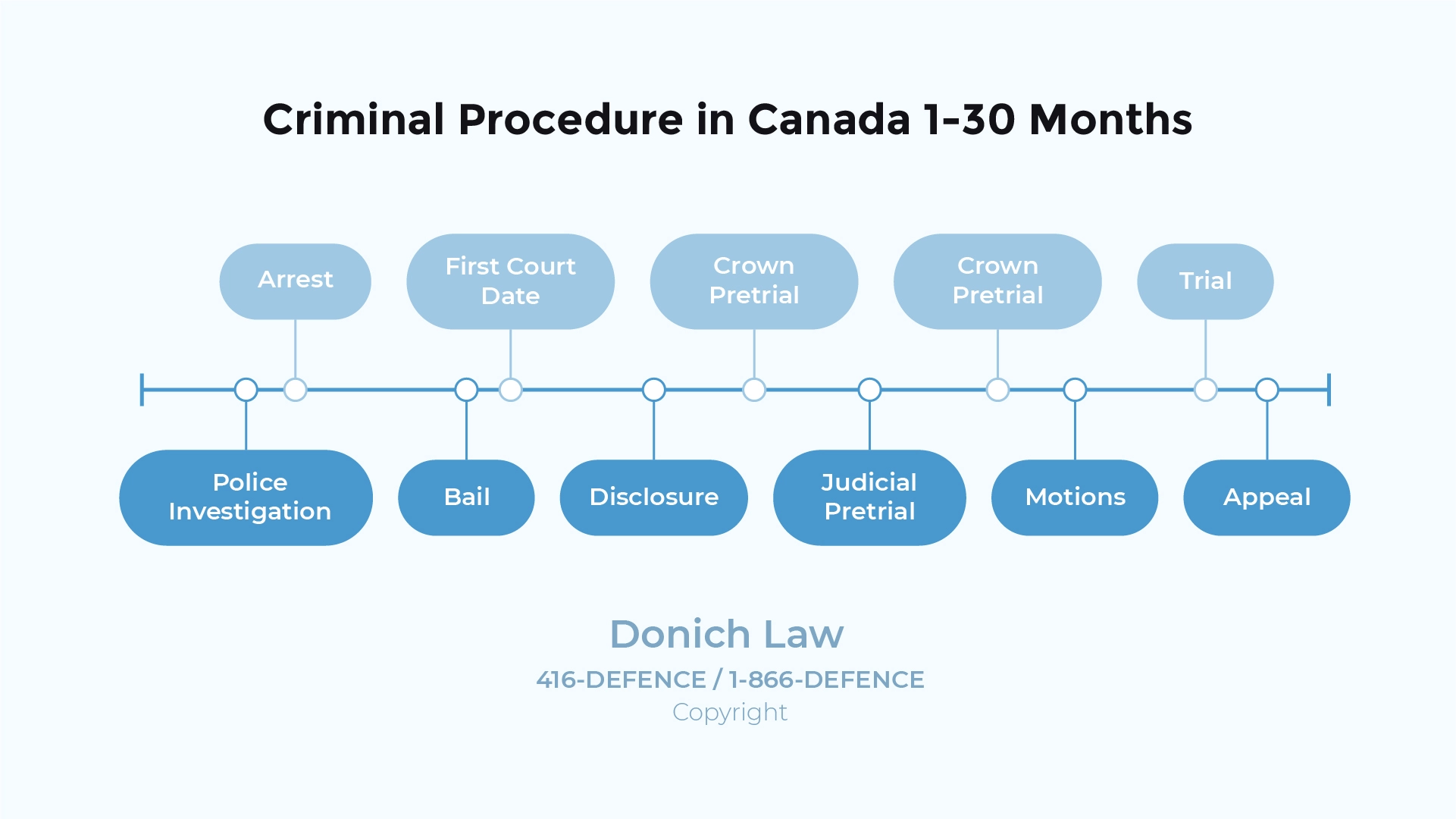
Stages of the Criminal Justice System
What if there is no Evidence of the Threat?
It is a common misconception that an individual cannot be convicted of a crime if there is no “evidence.” In reality, the statements of the complainant are considered to be evidence and if found to be reliable and credible, are enough to convict the accused.
In cases involving crimes like uttering threats, assault, or sexual assault, there is often little other evidence to prove the allegations. If no other witnesses were present at the time of the incident and there is no surveillance footage or other multimedia recording, the only evidence available may be the testimony of the complainant. Where the Court finds the complainant to be reliable and credible while testifying and are not left with reasonable doubt based on the other evidence presented at trial, they must convict the accused.
How to Defend an Uttering Threats Charge?
As with any criminal case, the burden of proof lies with the Crown to prove the accused’s guilt beyond a reasonable doubt. This means that the accused is not required to present any evidence if they do not wish. If the Crown is unable to prove the accused’s guilt beyond a reasonable doubt, the accused cannot be convicted.
As outlined above, in some cases involving uttering threats charges, there is no other evidence aside from the testimony of the complainant. In these situations, the trial becomes a he-said-she-said situation. To defeat the allegations in these circumstances, the defence must prove the complainant to be unreliable and lacking in credibility. Where the Court is left with reasonable doubt as a result of the lack of reliability and credibility, the Court must acquit the offender.
What’s a Crime in Canada?
Will I go to Jail for Uttering Threats?
It is possible for an individual convicted of uttering threats to be sentenced to a period of custody. This is, however, less common where the only charge against the accused is uttering threats. It is common for the charge of uttering threats to be laid along with other charges, especially when the threats occur in a domestic situation.
Pursuant to the Criminal Code, the maximum jail sentence an individual convicted of uttering threats can receive it five years in prison. In addition, or as an alternative to jail, the Court has the discretion to impose any other sentence available in the Code. This includes imposing a suspended sentence with probation, a conditional sentence (house arrest), or granting a conditional or absolute discharge.
When determining the appropriate sentence for an offender who has been convicted of uttering threats, the Court will consider the sentencing principals outlined in the Criminal Code as well as aggravating and mitigating factors. These factors may include the accused’s prior criminal history, past allegations of violence or domestic abuse, the offender’s age, the nature and circumstances of the offence, the impact on the complainant and any other relevant factors present in the case. Defence counsel will present the Court with mitigating factors to secure a lower sentence.
Law Newbie is a free AI research assistant that can help you safely answer questions about criminal law.


Recent Cases
R. v. O.A., 2026 ONCJ 88
In the 2026 case of R. v. O.A., the offender was found guilty at trial of two counts of utter threats related to his intimate partner, one count of utter threats related to the couple’s three children, and one count of assault related to his intimate partner. The Court heard evidence that on two occasions during an argument the offender had threatened to kill his spouse, and, on another occasion, he had stated he would “destroy the children.” Despite being found guilty, the offender maintained his innocence. The Court considered a victim impact statement from the complainant in which she described the negative effect her ex-partner’s abuse had on her life. In determining whether a suspended sentence or a conditional discharge was the correct sentence, the Court noted that many provincial court judges have found that a conditional discharge is never in the public interest in cases involving intimate partner violence. The Court issued a suspended sentence with 36 months’ probation. The Court also imposed a 10 year weapons prohibition and DNA order.
R. v. S.M., 2025 ONSC 6309
In the 2025 case of R. v. S.M., the offender was convicted, after a jury trial, of uttering threats to cause death to a close friend. The Crown and defence counsel presented a joint position on sentence to the Court which involved a conditional discharge with 12 months’ probation, a DNA order, and a five-year weapons prohibition. When the Crown and defence counsel present a joint position on sentence to the Court, the Court must accept the position unless it is completely unreasonable or not permitted under the law. The Court in this case noted concerns with the sentence given the severity of the allegations. The Court noted several aggravating factors in the case and expressed serious concerns with the appropriateness of the joint position. After a thorough review of the law, the Court accepted the joint position.
R. v. A.L., 2025 ONCJ 716
In the 2025 case of R. v. A.L., the offender was convicted of three counts of uttering threats, five counts of assault, three counts of assault choking, three counts of mischief, and one count of forcible confinement. The Crown proceeded by indictment. The Court found that the offender engaged in an on-going, sustained and escalating pattern of abuse over the course of a night. The offender hit, slapped, kicked and choked the complainant who was dating the offender. The offender threatened to kill the complainant throughout the ordeal. During sentencing, the Court noted that the offender had no prior criminal record, was well educated and provided numerous character references. The Court also noted that the offender attempted to minimize his actions and showed no remorse during trial or in his pre-sentence report. The offender was sentenced to a total of 15 months custody, with seven months attributed to the three counts of utter threats.


Breakfast Television
Mental Health Concerns in the Justice System.

CP24
The Difference between Criminal and Civil Liability.

CTV News National
The Rise of Gun Violence in Toronto.

Global News
New Changes to Pardons in Canada.
Related Content

Impaired Driving
Drinking and Driving is a Common Offence in Canada.

Drinking and Causing Death
Impaired Driving Causing Death has Serious Consequences.

First Offender Resources
Special sentencing Principles apply to First Offenders.

Travel Consequences
International Travel Could be a Problem with a Conviction.
About the Author

Jordan Donich
Jordan Donich has been a Lawyer for over 10 years and is a trusted legal analyst by Canadian Media. He is as a leader in Canada’s tech sector for lawyers and developer of Law Newbie. Jordan is a Black Belt with the Japan Karate Association and trained in Krav Maga. He won a Gold Medal at 2004 Canadian National Championships and was published in the National Newspaper Awards.
Jordan has been featured in Forbes, Canadian Lawyer and is a member of DMZ Angels in Toronto.
